
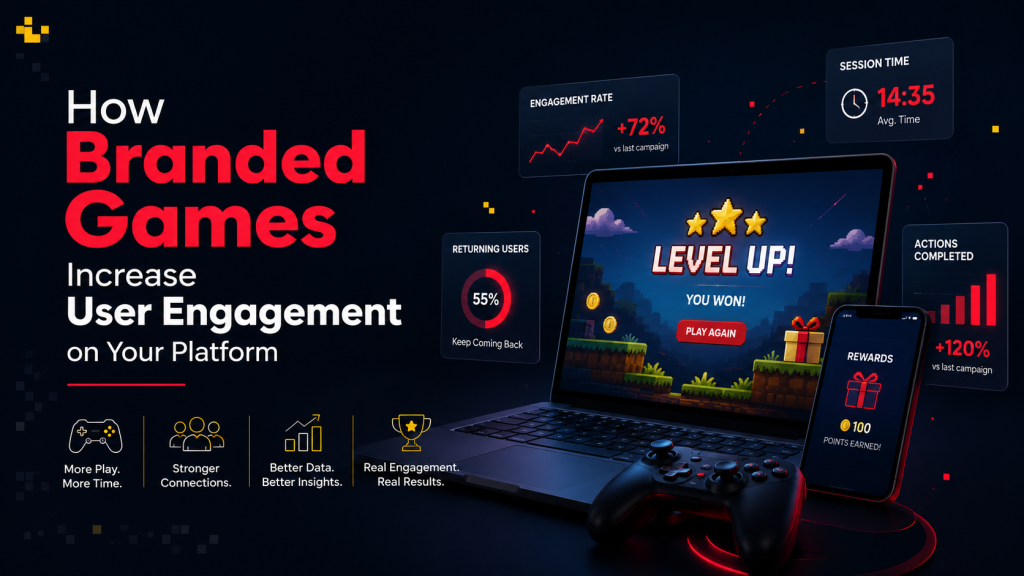
Branded games increase user engagement by turning a passive scroll into an active decision — and that shift in behaviour is measurable, not just a feel-good claim. At Myy Hashstash, we’ve built playable experiences for brands like Sony, Honda, Amazon, and Bajaj Finserv, and the pattern holds across all of them: give people something to play, and they stay longer, come back sooner, and remember you better.
Table Of Contents
What Counts as a "Branded Game" in 2026
“Branded game” gets used loosely, so it’s worth splitting into three tiers we actually build against. First, lightweight gamified features bolted onto an existing product — a streak counter, a spin-the-wheel discount popup, a points ledger. Second, embeddable mini-games licensed from a games hub and skinned in your colours. Third, a fully custom game: original mechanics, original IP, built around one specific brand objective from day one.
All three can work. But they’re not interchangeable, and the tier you pick decides how much of the upside below you actually get to keep.
The Psychology: Why Games Outperform Passive Content
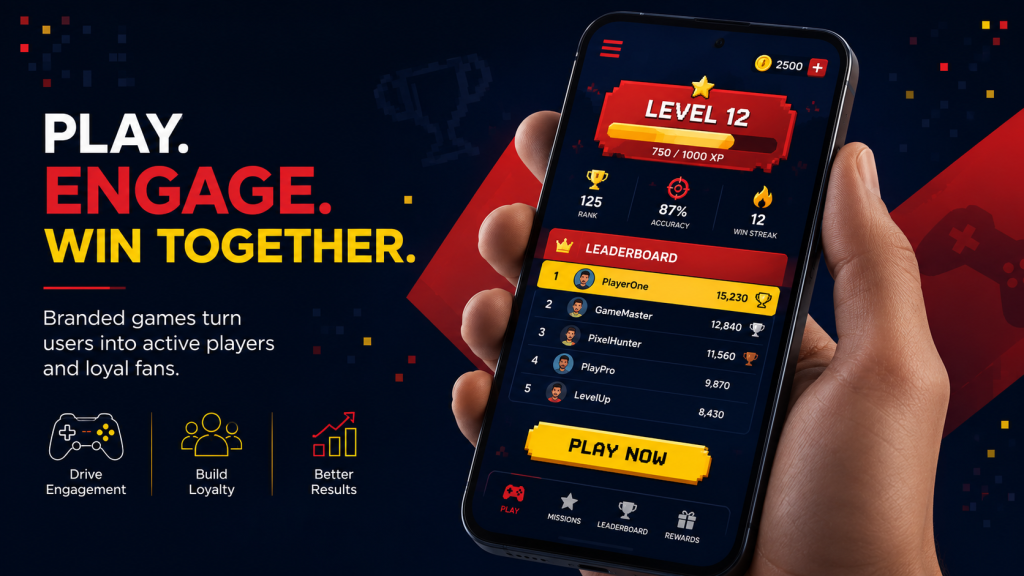
Games outperform banners and feeds because they satisfy three basic psychological needs: competence, autonomy, and relatedness. A user who wins a small in-game reward gets a dopamine hit that a static ad simply cannot deliver. That reward loop is what turns a one-time visitor into a habitual one.
This isn’t a hunch – it’s been studied directly. Research on gamified mobile apps has found that game elements increase engagement precisely because they meet those three needs, and that the resulting engagement carries through to real marketing outcomes like word-of-mouth and higher app ratings.
The mechanism matters more than the skin. A leaderboard works because it satisfies competence and relatedness at once – you can see exactly how you’re doing, and exactly how you compare to people like you. A daily spin works because it rewards a habit, not a purchase. Design the loop around the need it satisfies, not just the visual theme.
The Numbers: What Branded Games Actually Move
None of this matters to a marketing team unless it shows up in a dashboard. Here’s where branded games move the needle in ways platform owners actually track.
Retention & Repeat Visits
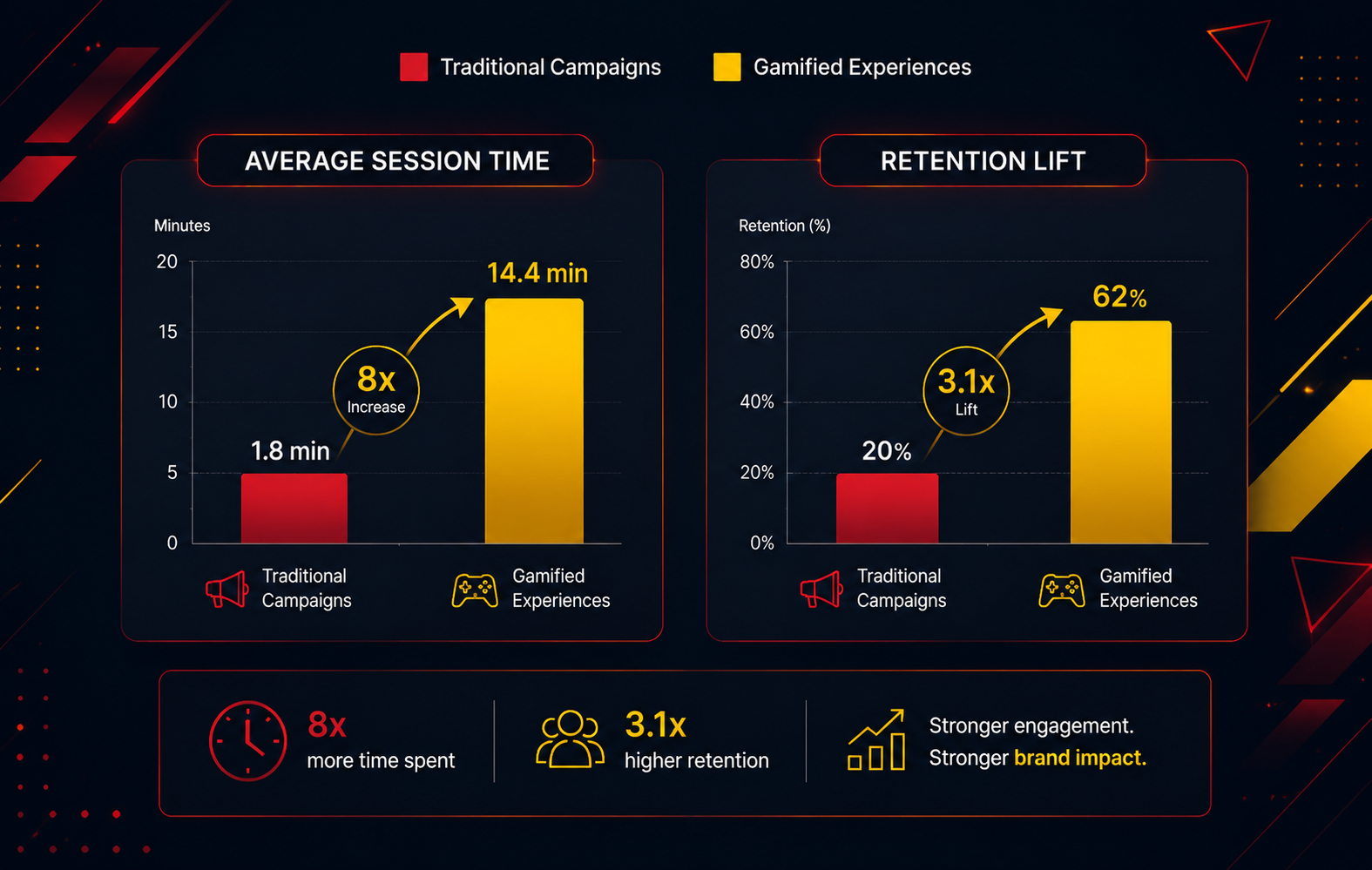
Mobile apps lose the vast majority of new users within days of install, and most abandon an app entirely within three months. Brands that add gamification to their apps see retention improve by roughly a fifth on average, and some app gamification programmes report engagement lifts approaching 50% once competitive or reward-based layers are added. A branded game is one of the fastest ways to give a user a reason to open your app again tomorrow.
Time-on-Platform & Session Depth
Apps with strong gamification see users spend more time per session meaningfully — figures in the 15–40% range come up repeatedly across platform data. For a content or commerce app, that extra time isn’t idle scrolling; it’s more product exposure, more ad impressions, more chances for a user to find something they’ll buy.
Data Capture & First-Party Insight
A game is also a data-collection instrument in disguise. Every level cleared, choice made, or reward claimed is a first-party signal about what a user actually likes — collected with consent, inside an experience people willingly opt into, at a time when third-party tracking keeps getting harder.
Real Brands, Real Games
This plays out across categories, not just games companies. Coca-Cola’s advergame let players collect bottle caps as a crab character, tying story progression to brand exposure rather than a banner. Taco Bell rebuilt its old countertop Coin Drop game as a digital in-app experience for its loyalty programme. Streaming platform MX Player added lightweight HTML5 mini-games and saw engagement on the platform roughly double.
We’ve run the same playbook on our own client work. Our Amazon Prime Day activation used a playable mechanic to turn a shopping event into something people actively participated in rather than just scrolled past — the same principle behind every example above, adapted to a live commerce moment instead of a loyalty app.
The common thread across all of these: the game was never bolted on as decoration. It was built around the one behaviour the brand actually wanted more of.
Where a Custom Build Beats a Templated Game Plugin
A templated game plugin is faster and cheaper, and it’s the right call for always-on, low-stakes engagement. A custom build wins when you need the mechanic tied to a specific product, a specific campaign moment, or your own IP — because a template can’t be shaped around your brand the way an original game can.
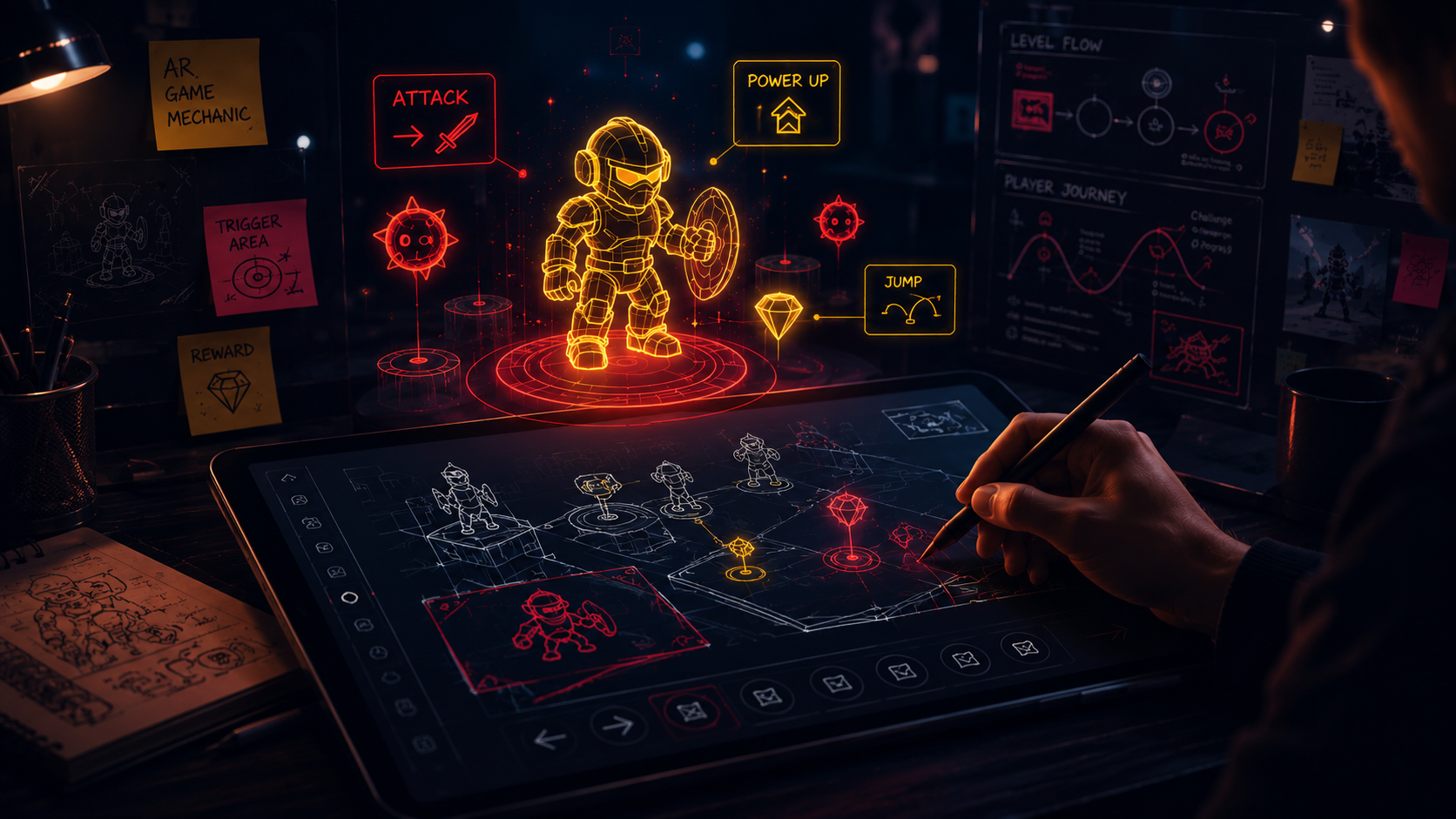
Templated mini-game hubs make sense when the goal is generic time-on-platform and you don’t need the game itself to say anything about your brand. But the moment you want the game to demonstrate a product feature, dramatise a launch, or extend into AR or Print AR — where a physical print ad becomes a playable augmented reality moment — a template can’t stretch that far. That’s custom-build territory, and it’s where a fully bespoke game outperforms a reskinned one on both engagement and brand recall.
How to Brief a Branded Game That Actually Drives Engagement
The brands that get the biggest lift from a branded game brief it in a specific order:
- Objective first. Retention, launch buzz, data capture, and footfall are four different games, not one game with four goals bolted on.
- Platform second. An in-app game, a WhatsApp-embedded game, and an in-store Print AR activation each need a different build — decide where people will actually play before deciding what they’ll play.
- Reward loop third. Decide what a win feels like and how often it happens. Too rare, and people give up before the habit forms; too easy, and the reward stops meaning anything.
- Brand integration last, not first. Logos and colours should sit inside a mechanic that’s already fun on its own — a game people only play because they’re told to isn’t a game at all.
Get those four decisions right before a single line of code gets written, and the engagement numbers in the sections above stop being someone else’s case study and start being yours.
Frequently Asked Questions
Q1. What is a branded game, exactly?
A branded game is any interactive game experience built around a company’s product, message, or IP — ranging from a simple gamified feature inside an app to a fully custom game built from scratch for one campaign.
Q2. Do branded games actually increase engagement, or is it a fad?
The data backs it up: gamified apps show meaningfully higher retention and longer session times than non-gamified equivalents, and the underlying psychology — reward, competence, competition — isn’t a trend, it’s how people are wired.
Q3. How much does it cost to build a custom branded game?
It depends heavily on platform, mechanic complexity, and whether AR or Print AR is involved. A templated mini-game is far cheaper than a bespoke build — get in touch with your goals, and we’ll scope it properly.
Q4. How long does a branded game take to develop?
A templated or lightly customised game can go live in days. A fully custom game with original mechanics and art typically takes several weeks, depending on scope and platform.
Q5. Can a branded game work inside an existing app, or does it need its own app?
Most branded games are designed to embed inside an existing app, website, or messaging platform rather than requiring a standalone download — that’s usually what keeps friction low and participation high.
Q6. What's the difference between gamification and a full custom game?
Gamification adds game-like elements (points, badges, streaks) to an existing product. A full custom game is a standalone playable experience built around its own mechanics, story, and reward system, purpose-built for one brand objective.
See what we’ve built for brands like Sony, Honda, and Amazon in our portfolio, or explore our full game development and interactive marketing services.