
How AR is transforming retail marketing in India is no longer a hypothetical question — it’s playing out in fitting rooms, packaging, social filters, and product pages across the country right now. Our team at Myy Hashstash builds AR experiences for brands every day, from Print AR campaigns to Web AR filters, and in this guide we break down how augmented reality is actually being used in Indian retail, why it works, and how brands can get started.
- The State of AR in Retail — Globally and in India
- How Brands Are Actually Using AR in Retail
- Why AR Works So Well for Retail Marketing
- The Indian Retail Context — Opportunities & Challenges
- Real Examples: Global Brands + How Myy Hashstash Has Applied This in India
- Getting Started with AR Retail Marketing
- FAQs
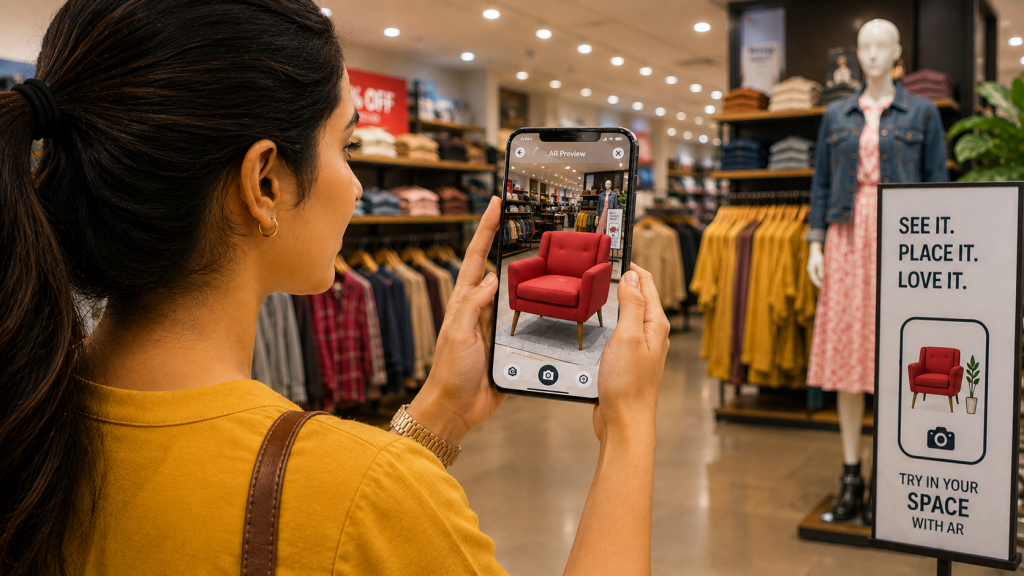
The State of AR in Retail — Globally and in India
The global AR in retail market is projected to grow at a CAGR of roughly 20% through the mid-2020s, and Asia-Pacific — led by countries like India, China, and Japan — is expected to be the fastest-growing region, driven by rising smartphone penetration and retailers’ growing focus on digital-first shopping experiences
This isn’t a distant trend. Industry market research points to Asia-Pacific as the fastest-growing AR retail region, and reporting on India’s retail sector has highlighted how rising smartphone penetration and internet access are making AR a natural fit for Indian retailers experimenting with augmented reality to improve customer engagement alongside AI and analytics-driven personalization. What was once considered a novelty — a filter here, a virtual mirror there — is becoming a standard part of how digitally mature retail brands compete for attention.
How Brands Are Actually Using AR in Retail
Virtual Try-On (Fashion, Beauty, Eyewear)
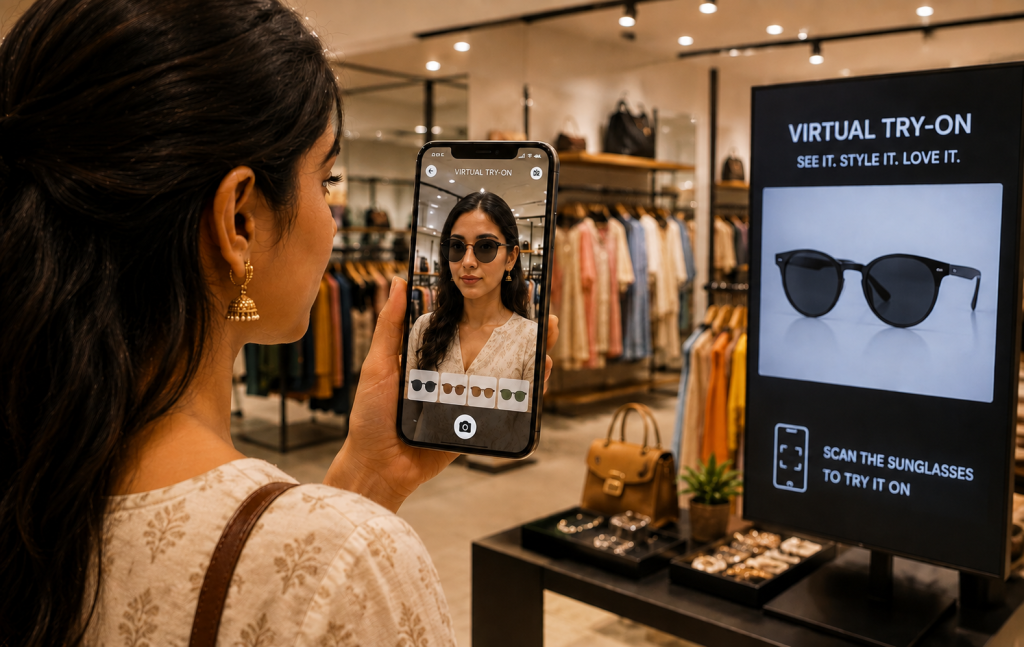
This is the most mature use case globally. Beauty brands let shoppers preview lipstick shades and foundation tones over a live camera feed; eyewear brands map virtual frames onto a user’s face; fashion brands overlay clothing onto a photo or live camera view. It directly addresses the biggest friction point in online shopping — not knowing how something will actually look.
In-Store AR & Smart Mirrors
Physical retail hasn’t been left behind. Smart AR mirrors in fitting rooms let shoppers try on outfits without changing, and in-store AR-oriented experiences have already started appearing in Indian retail, including fashion brands testing AR-enabled virtual try-on formats in their outlets.
Print AR — Bringing Packaging & Print Ads to Life
This is a distinctly powerful format for India’s market, where print and packaging still carry enormous reach. A product box, a magazine ad, or a poster becomes interactive the moment it’s scanned — unlocking a 3D product view, a game, or a branded video experience, without requiring the shopper to download a dedicated app.
AR Filters & Social Commerce
Instagram and Snapchat AR filters have become a low-friction way for brands to get shoppers actively engaging with a product before ever visiting a store or site — a face filter tied to a product launch, for instance, turns a passive ad into something shareable.
Why AR Works So Well for Retail Marketing
AR works for retail marketing because it converts passive viewers into active participants — letting shoppers virtually test a product before buying, which builds purchase confidence, reduces returns, and drives measurably higher engagement than static ads or images.
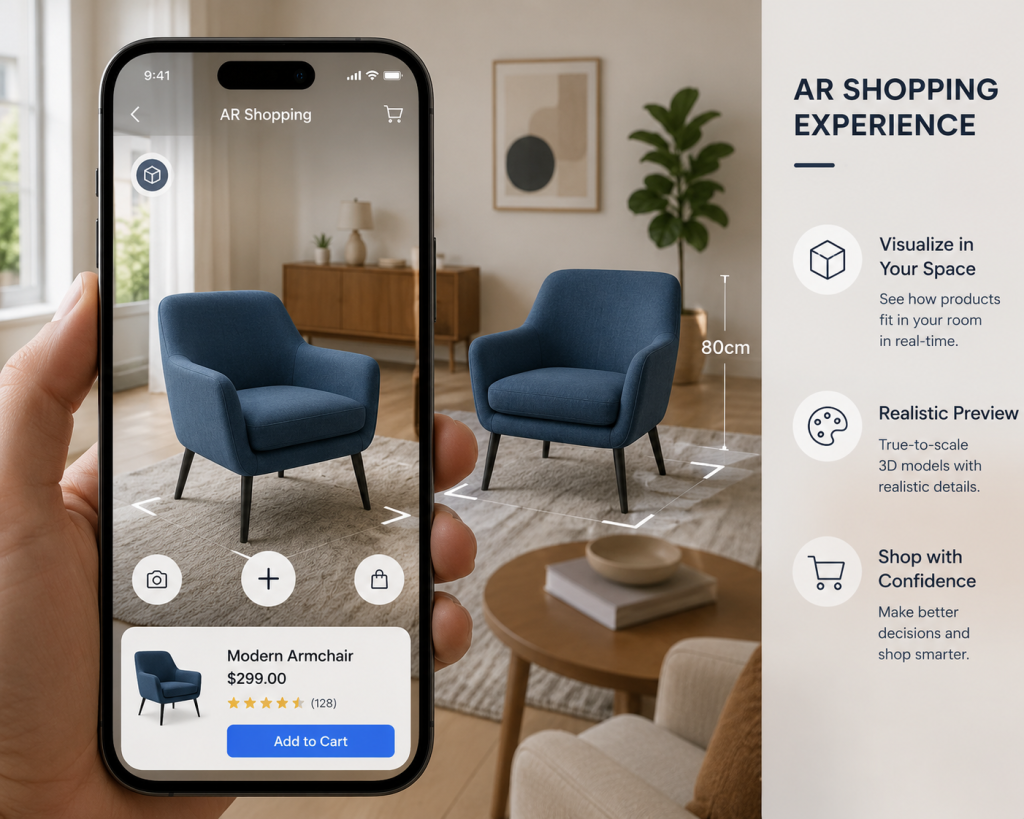
The “try before you buy” effect is the core of AR’s advantage: a shopper who has virtually tried on a lipstick shade or previewed furniture in their own living room is buying with far more confidence than one working off a product photo alone. That confidence shows up in the numbers retailers care about most — better engagement, longer time spent with a brand, and fewer returns from products that didn’t match expectations.
The Indian Retail Context — Opportunities & Challenges
Smartphone-First, WebAR Advantage
India’s retail AR opportunity is fundamentally smartphone-led. WebAR — AR experiences that run directly in a mobile browser via a QR code or link, no app download required — is particularly well-suited to Indian retail, where app-download friction can be a real barrier to adoption but nearly every shopper already has a capable smartphone camera.
Barriers: Cost, Awareness, Infrastructure
AR retail adoption in India still faces real hurdles: development costs, limited retailer awareness of what’s actually possible, and inconsistent digital infrastructure across smaller cities and tier-2/tier-3 markets. Brands that get this right tend to start with focused, well-scoped campaigns rather than trying to build an always-on AR platform from day one.
Real Examples: Global Brands + How Myy Hashstash Has Applied This in India
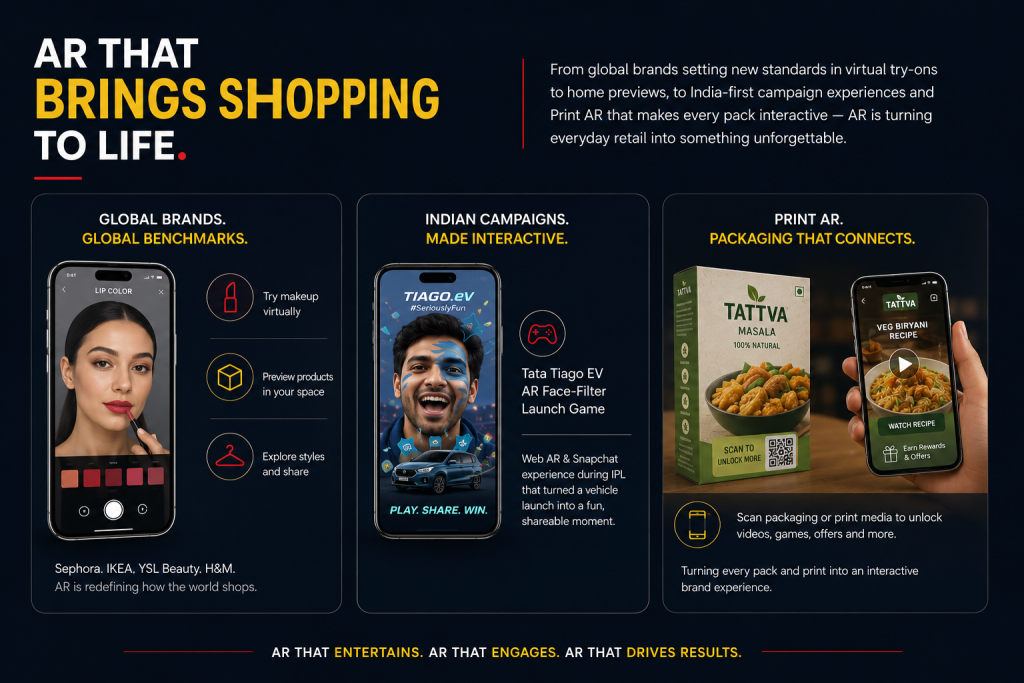
Globally, brands like Sephora, IKEA, and YSL Beauty have set the standard for AR retail experiences — virtual try-on tools that let shoppers test makeup shades or preview furniture in their own homes before purchasing. Fashion players like H&M have gone further, blending AR with gamification through virtual clothing lines and social sharing.
Closer to home, we’ve applied this same thinking to Indian retail and campaign work. Our Tata Tiago EV AR face-filter launch game, built for Web AR and Snapchat during IPL, turned a vehicle launch into an interactive, shareable experience rather than a static ad. We’ve also built Print AR executions that transform packaging and print media into scannable, interactive brand moments — proof that this technology works just as well for FMCG and auto as it does for beauty and fashion.
Getting Started with AR Retail Marketing
For brands considering AR for the first time, the most reliable path is to start narrow: pick one product line or one campaign moment, choose a format that fits your audience (WebAR for broad reach, an app-based experience for a loyal existing user base, Print AR for packaging-heavy categories), and measure engagement before scaling further. This keeps early investment controlled while building the internal case for a bigger AR strategy.
How we can help?
If you’re exploring what AR could look like for your retail brand, Myy Hashstash’s AR & VR development team can help scope the right format for your product and audience — get in touch to talk through your specific campaign.
Closer to home, we’ve applied this same thinking to Indian retail and campaign work. Our Tata Tiago EV AR face-filter launch game, built for Web AR and Snapchat during IPL, turned a vehicle launch into an interactive, shareable experience rather than a static ad. We’ve also built Print AR executions that transform packaging and print media into scannable, interactive brand moments — proof that this technology works just as well for FMCG and auto as it does for beauty and fashion.
Frequently Asked Questions
Q1. What is AR in retail marketing?
AR in retail marketing uses augmented reality technology to overlay digital content — like virtual try-on tools, 3D product views, or interactive filters — onto the real world through a smartphone camera or smart mirror, letting shoppers engage with products before buying.
Q2. How is AR used in Indian retail specifically?
Indian retailers are using AR through virtual try-on tools, in-store AR mirrors, Print AR campaigns that bring packaging to life, and social media AR filters — with WebAR being particularly effective given India’s smartphone-first shopping behavior.
Q3. Does AR actually increase sales or engagement?
Yes — AR-enabled shopping experiences consistently show higher engagement and purchase confidence than static content, largely because they let shoppers try before they buy, which also tends to reduce product returns.
Q4. What is Print AR and how does it work?
Print AR turns physical packaging, posters, or print ads into interactive digital experiences — a shopper scans the printed material with their phone camera to unlock a 3D view, video, or game, without needing to download a dedicated app.
Q5. Is AR retail marketing expensive to implement?
Costs vary by scope and format — a focused WebAR or Print AR campaign for a single product line is far more accessible than building a full always-on AR platform, which is why most brands start with a narrow, measurable pilot.
Q6. What's the difference between AR and VR in retail?
AR overlays digital content onto the real world through a camera (like a virtual try-on), while VR creates a fully immersive digital environment that replaces the real world entirely — retail marketing today leans heavily on AR because it works directly through a shopper’s existing smartphone.