
The best game engines for 3D game development in 2026 come down to three names for most teams – Unity, Unreal, and Godot – but the right pick depends entirely on your platform, your budget, and how photoreal you need to be. This guide compares the leading 3D engines, their real strengths and trade-offs, and which one fits which kind of project.
Table Of Contents
Best game engines for 3D game development: quick picks
For most 3D projects in 2026: choose Unity for mobile, cross-platform, and branded games; Unreal Engine for the highest visual fidelity and AAA or photoreal work; and Godot for lean, open-source, or experimental builds. For no-download browser and WebAR playables, a lightweight WebGL framework beats all three.
There’s no single “best” engine – only the best one for your goal. Below is what each does well and where it doesn’t.
How to choose a 3D game engine
Before the brand name, weigh six things:
- Target platform — mobile, PC, console, web, or VR/AR.
- Visual fidelity — stylised and clean, or full photorealism.
- Team experience — C#, C++, GDScript, or visual scripting.
- Budget and licensing — royalties, seat costs, revenue thresholds.
- Timeline — how fast you need to prototype and ship.
- Long-term plan — one campaign, or a platform you’ll keep building on.
Get those straight and the shortlist usually picks itself.
Unity 6
Unity is the most popular engine for mobile and cross-platform games, and it stays the strongest choice for mobile in 2026. Its iOS and Android build pipeline is mature, the asset store is huge, and Unity Gaming Services handles monetisation, analytics, and multiplayer inside the engine. It runs on C#, which is friendlier than C++ for most teams.
Pros: unbeatable platform reach (mobile, PC, console, WebGL, VR/AR), fast prototyping, massive ecosystem, gentle learning curve.
Cons: top-end visuals need work to match Unreal; licensing terms have shifted in recent years, so read the current pricing.
Best for: mobile games, branded and playable ads, cross-platform titles, VR/AR, and quick campaign builds. It’s our most common pick for brand work.
Unreal Engine 5
Unreal is the fidelity king. If you’re chasing photorealism on PC, PS5, or next-gen consoles, it’s the default. Unreal Engine 5 has moved past its experimental phase into a mature production powerhouse, and it’s a favourite for AAA titles and virtual production. It’s free until a project earns $1M in revenue.
Pros: best-in-class graphics and rendering, superb for cinematics and virtual production, strong free asset marketplace.
Cons: steep learning curve, resource-heavy (it wants powerful hardware), and C++ can be tough for non-specialists.
Best for: high-end, photoreal experiences, product films, and flagship 3D projects where visuals are the point.

Godot 4
Godot is the open-source challenger and the fastest-growing engine by almost every adoption metric — GitHub stars, community size, new releases. It’s completely free with no royalties, extremely lightweight (the editor is under 100MB), and quick to iterate in.
Pros: free forever, no royalties, tiny footprint, fast iteration, intuitive UI.
Cons: 3D performance and features still trail Unity and Unreal slightly, and the asset ecosystem is smaller.
Best for: smaller, stylised, experimental, or open-source-friendly projects, and teams that want full control without licensing strings.

Other engines worth knowing
- CryEngine — gorgeous visuals, but a niche choice with a smaller talent pool.
- GameMaker — excellent for 2D, not built for serious 3D.
- Phaser / three.js (WebGL) — the go-to for browser games, playable ads, and WebAR experiences that need to run instantly with no download.
Where 3D game engines are heading in 2026
Two shifts are worth watching. First, AI is moving into the engines themselves – generative tools for assets, animation, and even NPC dialogue are shortening production timelines across Unity and Unreal. Second, cloud-based build and streaming pipelines mean high-fidelity 3D can reach low-end devices, so your choice of engine no longer locks out part of your audience. Neither changes the core picks above, but both make 3D cheaper and faster to ship than it was a year ago.
Where 3D game engines are heading in 2026
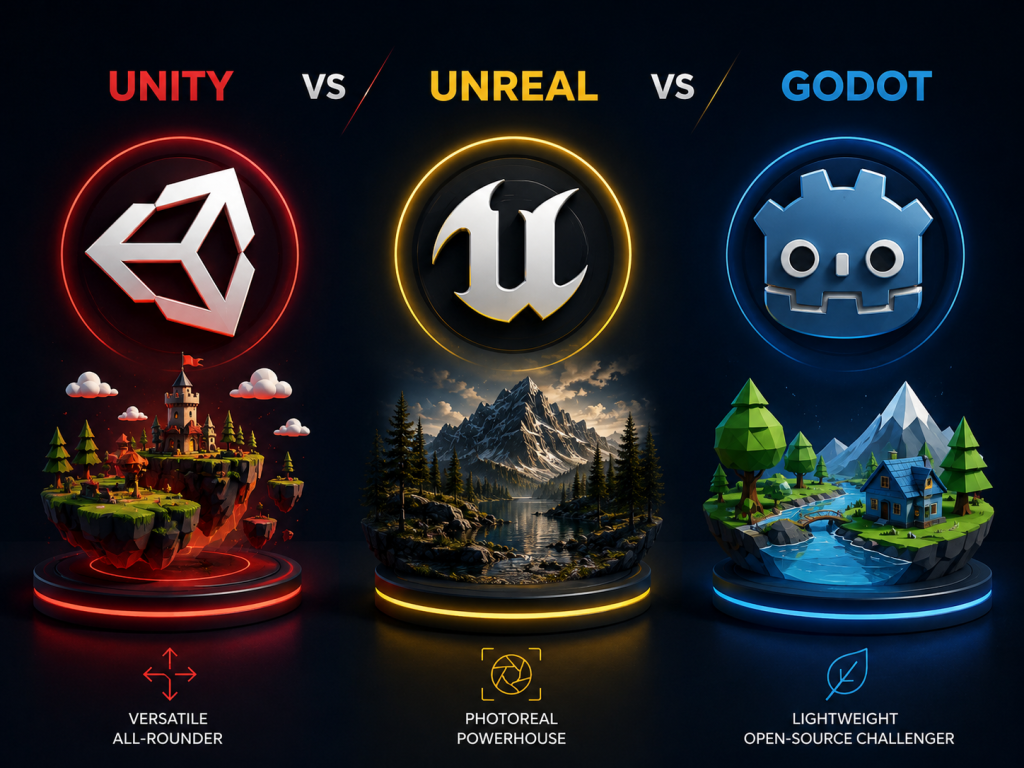
| Engines | Unity 6 | Unreal Engine 5 | Godot 4 |
|---|---|---|---|
|
Best for |
Mobile, cross-platform, branded games |
Photoreal, AAA, virtual production |
Lean, indie, experimental |
|
Visual fidelity |
High |
Highest |
Good (improving) |
|
Learning curve |
Moderate |
Steep |
Gentle |
|
Language |
C# |
C++ / Blueprints |
GDScript / C# |
|
Cost |
Tiered licensing |
Free to ₹10L revenue |
Free, open-source |
|
Mobile strength |
Excellent |
Good |
Growing |
Which engine should your business pick?
Match the engine to the job:
- Branded mobile game or playable ad → Unity.
- Photoreal product experience or brand film → Unreal.
- Lean, experimental, or tight-budget build → Godot.
- No-download web or WebAR activation → a WebGL framework like three.js.
At Myy Hashstash, we’re engine-agnostic — we pick per project, not per habit. Most of our branded games and interactive work runs on Unity for its reach, while flagship 3D builds lean on heavier tooling. If you’re still deciding between formats, start with our 2D vs 3D game development guide, and for the bigger picture, see our complete guide to 3D game development for business.
Frequently Asked Questions
Q1. Which game engine is best for beginners?
Godot for its gentle learning curve and zero cost, or Unity for its huge library of tutorials and jobs. Both are far more approachable than Unreal’s C++.
Q2. Unity or Unreal for 3D games?
Unity for mobile, cross-platform, and branded games; Unreal when top-tier photorealism is the goal. Platform and visual bar decide it.
Q3. Is Godot good for 3D?
Yes, and improving fast — but for demanding, high-fidelity 3D it still trails Unity and Unreal slightly. Great for lean and stylised projects.
Q4. What's the best engine for mobile 3D games?
Unity, comfortably. Its mobile build pipeline, performance tooling, and ecosystem are the most mature for iOS and Android.
Q5. Which engine do studios use for branded games?
Most commonly Unity, because it ships fast across platforms and handles analytics and monetisation in-engine — exactly what brand campaigns need.