
Choosing between 2D and 3D game development is one of the first – and most expensive – decisions a brand makes before building a game. Get it right, and the format matches the goal. Get it wrong, and you either overspend on realism nobody needed, or under-build an experience that falls flat. This guide gives you a clear framework: the real differences, the cost and timeline gap, and how to pick the right one for your objective
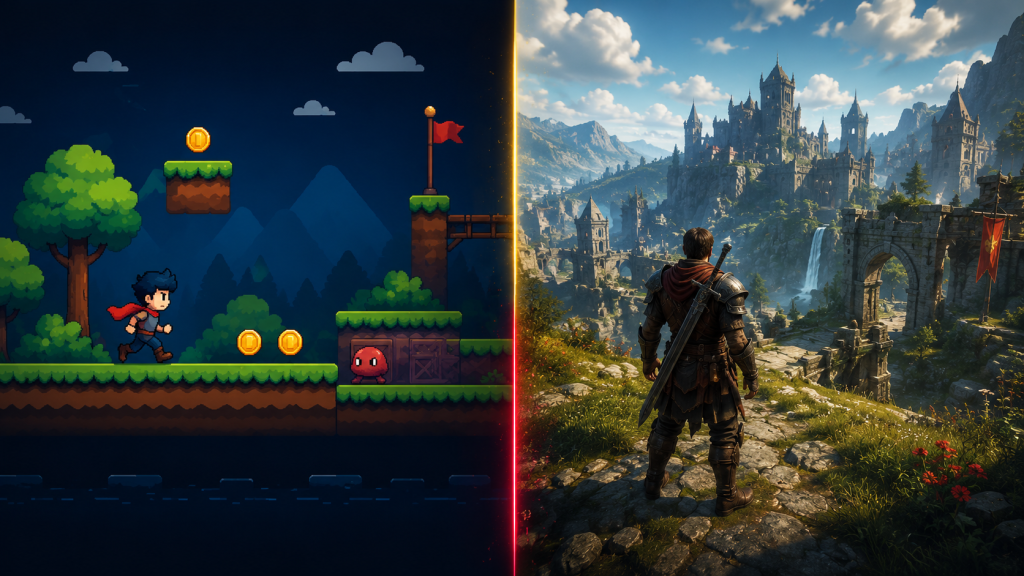
Table Of Contents
- 2D vs 3D game development: the quick answer
- What’s the actual difference?
- Cost and timeline compared
- 2D game development: pros, cons, and best uses
- 3D game development: pros, cons, and best uses
- Which should your business choose?
- Start 2D, scale to 3D? And the low-poly trend
- How we decide at Myy Hashstash
- Frequently Asked Questions
2D vs 3D game development: the quick answer
Choose 2D for speed, lower cost, and stylised campaigns — puzzles, casual arcade games, quick brand builds. Choose 3D for immersion, realism, and spatial interaction — product showcases, virtual spaces, and premium experiences. If budget and time are tight, start 2D; if depth is what sells the message, go 3D.
That’s the short version. The rest of this guide is about knowing why, so you can defend the call to your team and your budget.
What's the actual difference?
The core difference is dimension. A 2D game lives on a flat X and Y plane — left, right, up, down. A 3D game adds a Z-axis, so objects have depth and the camera can move freely through space.
That one change ripples through everything. 2D art is drawn or illustrated; 3D art has to be modelled, textured, rigged, and lit. 2D animation is often frame-by-frame; 3D animates a rig. 2D rarely needs a physics engine; 3D usually does. Controls and camera get simpler in 2D and far more involved in 3D. None of this makes one “easier” — they’re hard in different ways. 2D demands tight, precise design. 3D demands more moving technical parts.
Cost and timeline compared
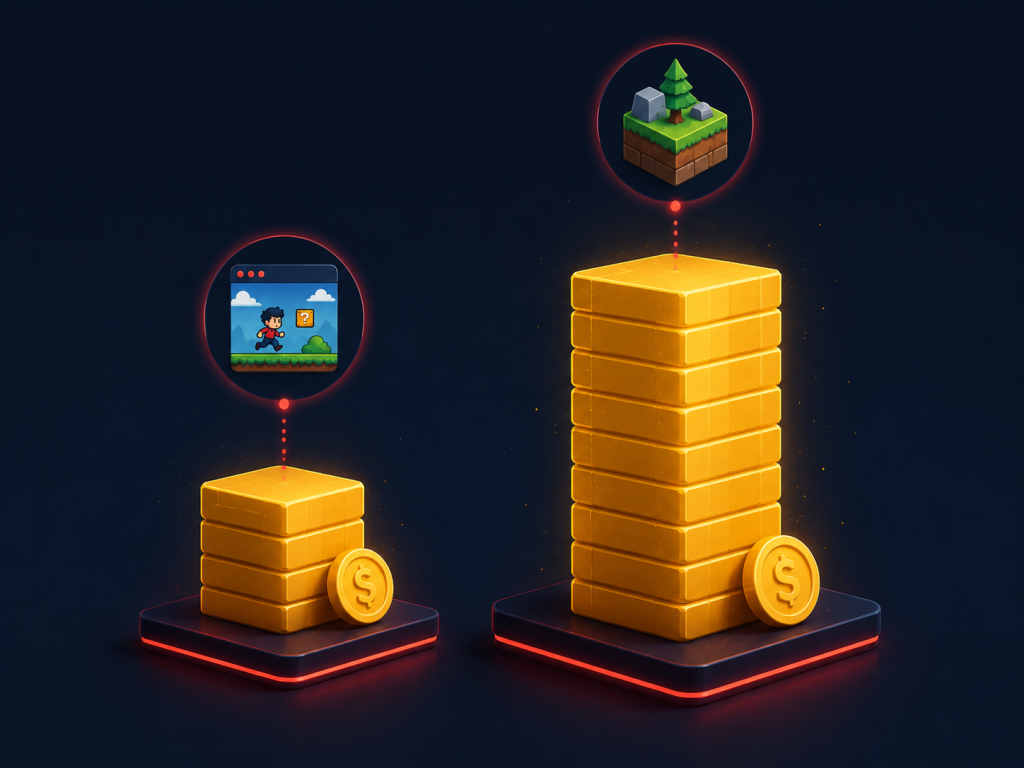
2D games typically cost about ₹5 lakh – ₹60 lakh+ and take 2–6 months to build. 3D games run roughly ₹25 lakh – ₹8 crore+ and take from 6 months to well over a year, because modelling, texturing, animation, and larger specialist teams all add up. For most brand campaigns, 2D is the faster, cheaper entry point.
| Factor | 2D | 3D |
|---|---|---|
|
Typical cost |
₹5 lakh – ₹60 lakh+ |
₹25 lakh – ₹8 crore+ |
|
Timeline |
2 – 6 months |
6 months – 2+ years |
|
Team size |
Smaller, leaner |
Larger, more specialist |
|
Best for |
Fast, stylised, casual campaigns |
Immersive, premium, spatial experiences |
2D game development: pros, cons, and best uses
Pros: lower cost, faster iteration, smaller team, and freedom to push a bold, stylised art direction without chasing realism. Simpler controls make 2D approachable for casual audiences.
Cons: less depth and perceived realism, weaker fit for VR/AR, and — counter-intuitively — smooth 2D animation can be art-heavy, since complex movement may need many hand-drawn frames.
Best for: casual campaign games, puzzles and arcade mechanics, quick product launches, and tight budgets where speed to market matters more than spectacle.
3D game development: pros, cons, and best uses
Pros: immersion and realism, freedom of movement and exploration, ambitious open-world mechanics, and a natural fit for VR/AR and product visualisation. It simply feels more premium.
Cons: higher cost, longer timelines, and a need for specialist 3D art and technical pipelines. Without that experience in-house, every new feature costs disproportionately more.
Best for: product showcases where a realistic model beats a photo, virtual spaces and metaverse builds, training simulations, and premium brand experiences.
Which should your business choose?
- What’s the goal? Awareness and reach lean 2D; immersion, product depth, or a flagship experience lean 3D.
- What’s the budget and timeline? Weeks and a lean budget point to 2D. Months and real investment open up 3D.
- What platforms? Web and casual mobile favour lightweight 2D; VR/AR and console-grade experiences need 3D.
- Does depth actually serve the message? If someone needs to circle a product, walk a space, or feel presence — that’s a 3D job. If not, 3D is money spent on realism the campaign didn’t need.
Start 2D, scale to 3D? And the low-poly trend
You don’t have to pick once and forever. Plenty of brands launch a 2D campaign game, prove the engagement, then reinvest in a richer 3D follow-up. It’s a sensible way to de-risk the spend.
The line is also blurring. In 2026, stylised low-poly 3D and advanced 2D lighting and particle effects sit close together — so you can get a premium, dimensional feel without a full AAA-3D budget. Low-poly is often the sweet spot for brands that want 3D energy at closer to 2D cost.
How we decide at Myy Hashstash
We start from the brand goal, never the tech. A fast, funny IPL campaign might be perfect in 2D; a flagship world like our Loka metaverse only works in full 3D. Because our team builds both — plus AR, CGI, and the marketing around them — the recommendation is honest, not steered toward whatever we’d rather sell. Once the format’s decided, engine choice comes next; see our blog on the best game engines for 3D game development.
Frequently Asked Questions
Q1. Is 2D or 3D game development cheaper?
2D is significantly cheaper — roughly ₹5 lakh – ₹60 lakh+ vs ₹25 lakh – ₹8 crore+ for 3D — because it needs smaller teams and no 3D modelling pipeline.
Q2. Is 3D harder to build than 2D?
Neither is strictly easier; they’re hard differently. 2D needs precise design and lots of animation art; 3D needs modelling, texturing, physics, and a bigger specialist team.
Q3. Which is better for mobile games?
Both work on mobile. 2D suits lightweight casual games; low-poly or optimised 3D suits richer experiences, but watch performance on lower-end devices.
Q4. Can we convert a 2D game to 3D later?
Not directly — it’s effectively a rebuild. But launching 2D first to validate engagement, then investing in 3D, is a common and sensible path.
Q5. Which is better for a branded marketing game?
It depends on the goal: 2D for fast, wide-reach campaigns; 3D when immersion or product realism carries the message. Match the format to the objective.